So I’m sitting here way too late at night, the kitchen light doing that faint buzzing thing — you know the one — & I’m trying to explain Spanish pottery identification in a way that actually helps, not in that “here are five generic tips” way that makes you want to throw your mug at the wall. Actually no, let me rephrase… I want you to feel like you can pick up a piece of pottery at a flea market in Valencia or some dusty antique shop in Toledo & have at least a fighting chance of knowing what you’re holding. Not certainty. Just… better odds.
Because here’s the thing nobody tells you: identifying Spanish pottery is messy. It’s vibes plus clues plus a little bit of “huh, that’s weird.” It’s not an exact science. Half the time you’re wrong. The other half you’re only mostly wrong. But you get better. You start noticing stuff. Like clay color — which, yes, everyone talks about — but it’s still useful. Spanish red clay can be deep terracotta, almost brick-like, especially in pieces from the south. But then you’ll pick up something from Catalonia that’s pale & sandy & you’ll think, “Oh cool, I’ve cracked the code,” and then boom, you find a workshop in Extremadura using the same pale clay & suddenly you’re questioning your entire life. Or maybe that’s just me.
Texture helps too. Some regions fire their clay hotter, so the body feels denser, almost stone-like. Others leave it slightly softer, more porous. Run your thumb along the unglazed base — gently, unless you want to leave skin behind — and you’ll feel those differences. But again, unreliable. Workshops borrow techniques from each other all the time. I once bought a bowl in Córdoba that felt exactly like something from Talavera, and I swear I could smell oranges while I was holding it, which made no sense because I was indoors & the only thing on the table was my cold coffee. (Which I then spilled. Obviously.)
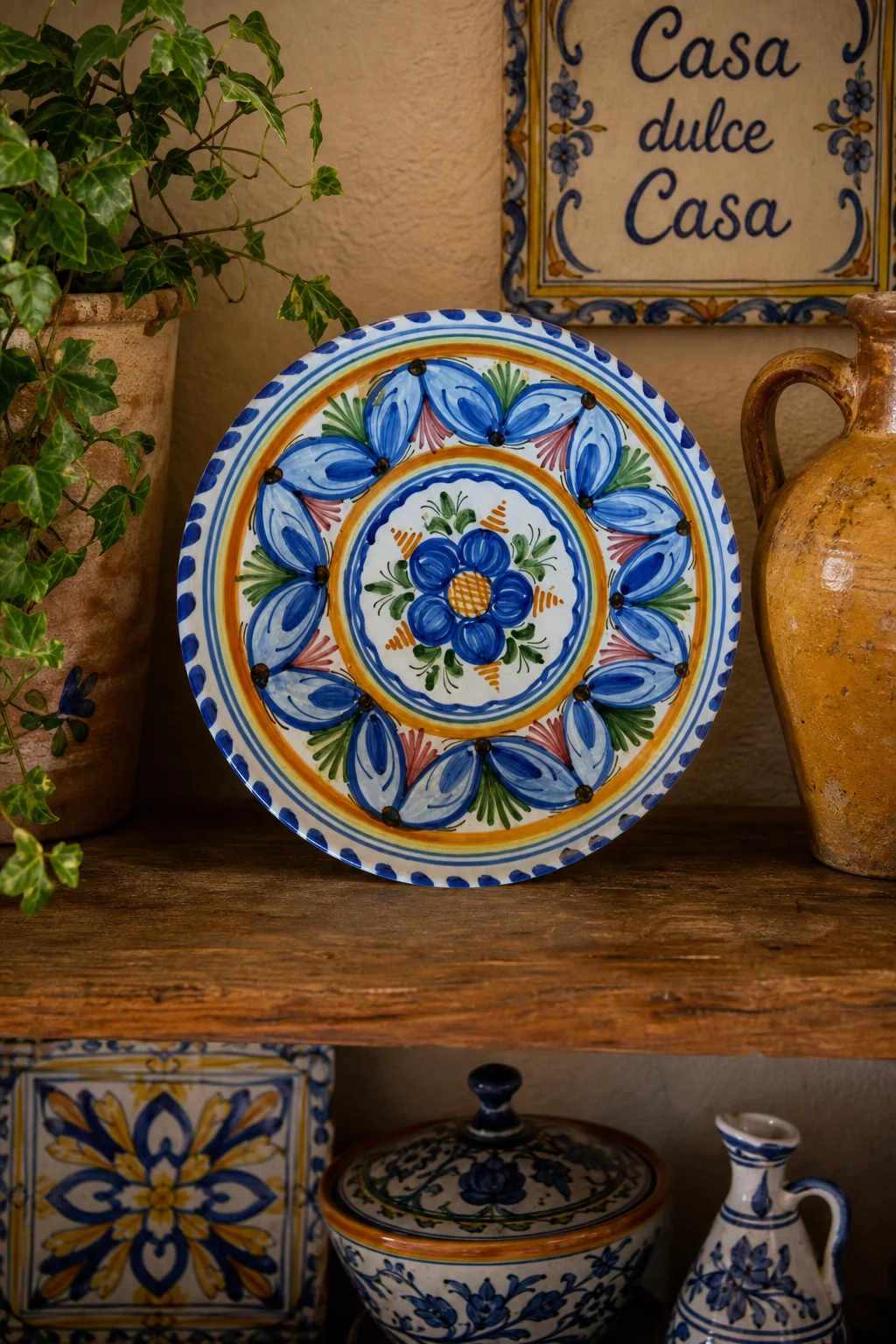
Glaze style is where things get fun. Spanish glazes have personalities. Andalusian greens that look like melted emeralds. Talavera blues that go from soft sky to deep cobalt in the same brushstroke. Valencia’s bright, almost cheeky yellows. But glazes fade, crack, get overfired, underfired, repaired, or — my personal micro-opinion — ruined by people who insist on scrubbing them with steel wool. So yes, glaze can tell you a lot, but it can also lie to your face.
Decorative motifs are another rabbit hole. You’ll see the classic Talavera florals, the geometric Moorish-inspired patterns, the goofy little birds that show up in pieces from Puente del Arzobispo, the bold stripes from Catalonia. Motifs can be super helpful… until they’re not. Because artisans copy each other. Tourists request “the blue one with the flowers” & suddenly every workshop from Seville to Zaragoza is painting the same thing. So motifs are clues, not answers. Treat them like gossip — interesting, but not gospel.
Shape is sneakily important. Some regions have signature forms: the tall, narrow jugs from the south, the squat handled bowls from the east, the lidded storage jars from central Spain. But shapes travel. A potter moves workshops, marries someone from another region, or just decides to try somethng new one year, and suddenly the shape you thought was a dead giveaway is just… a shape. Still, pay attention. If you see a form repeated across multiple pieces in the same stall, ask where they came from. People love telling origin stories, even when they’re half-made-up.
Weight is one of those things you only learn by handling a lot of pottery. Some Spanish pieces are surprisingly heavy — like, “did they mix lead into this?” heavy — while others feel almost too light for their size. Weight can hint at clay density, firing temperature, even age. But it’s subtle. And sometimes you’re just tired & everything feels heavy. Or maybe that’s me again.
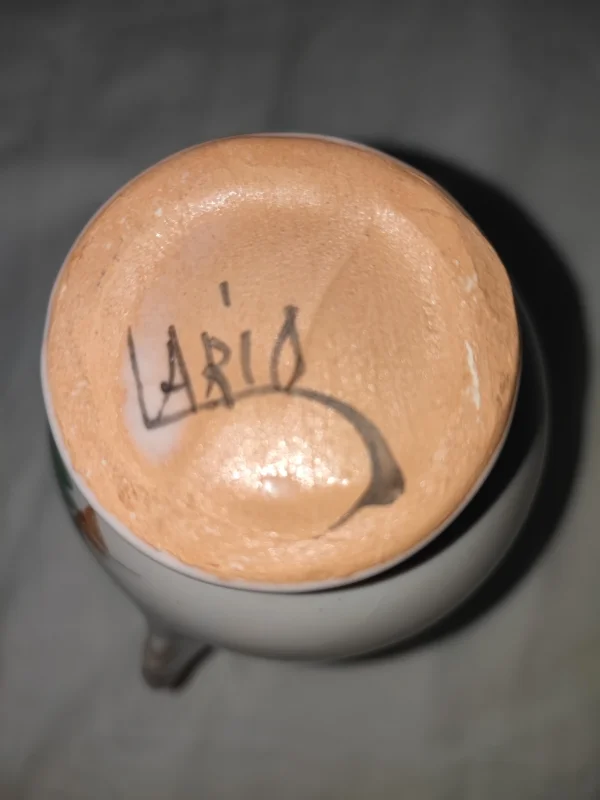
Oh — pottery marks. You already saw the first post in this category, so you know the drill: marks help, but they’re chaotic. Some are clear. Some are smudged. Some are missing entirely. Some are fake. Some are real but look fake. Some are just initials that could belong to any of 400 potters. Marks are like the friend who says they’ll pick you up at 7 & shows up at 9:30 with no explanation. Useful, but only when they feel like it.
Anyway, the real trick is layering all these clues together. Clay + glaze + motif + shape + weight + whatever mark you can decipher. None of them are reliable alone, but together they start forming a picture. A fuzzy one, sure, but a picture. And the more pieces you handle, the sharper that picture gets. It’s like training your brain to notice tiny things — the way a brushstroke curves, the way a foot ring is trimmed, the way a glaze pools at the base of a handle. You start trusting your instincts. You start being right more often than not. And honestly, that’s enough.
Anyway I’m rambling & the buzzing light is getting louder & I think something smells like toast even though I definitely didn’t make toast, so I’m just going to stop here, thanks for keeping with me!
To accurately date vintage Spanish pottery, look for an irregular network of fine, continuous glaze cracks (craquelure) combined with soft, unpolished abrasion on the unglazed foot rim. Genuine age-driven crazing spreads naturally across surfaces and into hidden recesses over decades due to moisture shifts and temperature changes, whereas artificial...
Spanish pottery marks can be fascinating, but they are not always easy to read. A stamp may be faded, a signature may look like a scribble, or the base may be covered by glaze and wear. Even so, these marks can offer valuable clues about a piece’s origin, maker, and...